

And why design matters more than components
Most conversations about home energy start in the wrong place.
They focus on panel wattage, battery size, or headline savings — as if a home energy system were a static product you simply bolt onto a house.
In reality, a modern home energy system behaves much more like infrastructure: quiet, responsive, and constantly balancing what your home needs with what’s available.
Understanding that difference — without needing to become an engineer — is the key to understanding why system design matters so much.
A home energy system isn’t “on” or “off”
One of the biggest misconceptions is that solar panels and batteries work in fixed steps or modes.
They don’t.
A well-designed system is continuously active, responding in real time to what’s happening in the home:
- How much energy is being generated right now
- How much the home is using right now
- Whether energy should be stored, released, or supplemented from the grid
There’s no waiting, batching, or manual switching. The system is always balancing supply and demand quietly in the background.
Solar output isn’t constant — and that’s normal
Another common assumption is that a solar system produces a fixed amount of energy throughout the day.
In reality, solar output rises and falls naturally:
- with the position of the sun
- with passing cloud cover
- with seasonal daylight hours
A good system isn’t designed around perfect conditions. It’s designed to behave sensibly across all the imperfect ones.
This is why looking only at peak ratings or headline numbers misses the point. What matters is how the system behaves over the course of a real day.
Your home’s energy use is always changing
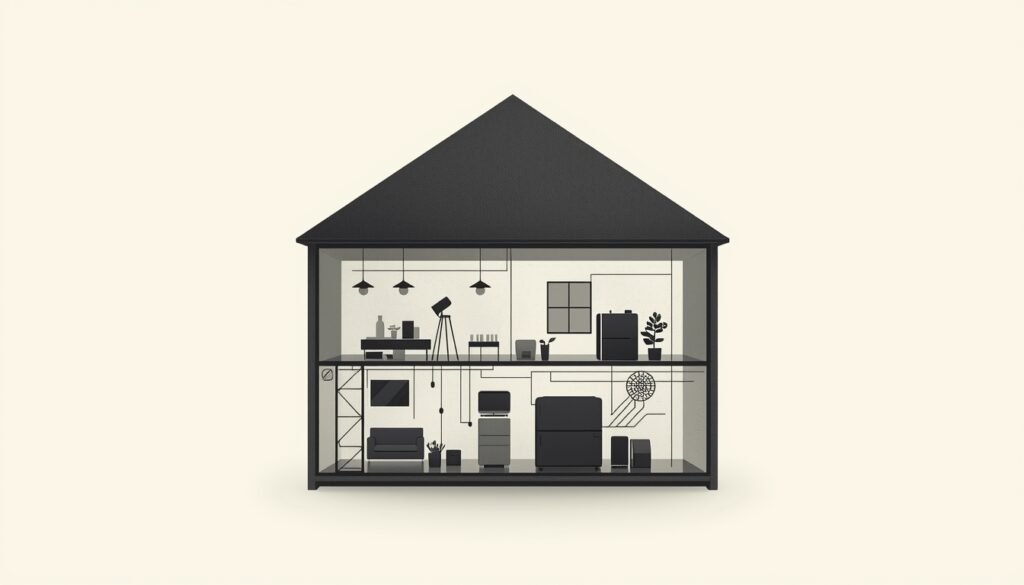
Homes don’t use energy evenly.
Demand increases and decreases constantly as people:
- make drinks or cook meals
- work from home
- charge devices or vehicles
- settle into the evening
A modern home energy system doesn’t need to predict every action. It simply reacts — supplying energy from the most appropriate source at that moment.
From the homeowner’s point of view, this is seamless. There are no decisions to make and no behaviour to change.
Batteries aren’t just for storing sunshine
It’s easy to think of a battery as something that fills up during the day and empties at night.
In practice, batteries are more useful than that.
They allow energy to be shifted across time — smoothing out the natural mismatch between when energy is available and when homes actually need it.
This is especially important during:
- evenings, when solar production falls but demand rises
- winter months, when daylight hours are shorter
The value of a battery isn’t just how much it can store, but how intelligently it’s integrated into the wider system.
The grid still plays a role — by design
Even in well-designed systems, the grid remains part of the picture.
Not as a failure point, but as a flexible partner:
- providing backup when needed
- absorbing excess energy when appropriate
- supporting the system during seasonal extremes
The goal isn’t to eliminate the grid at all costs. It’s to use it intelligently, alongside on-site generation and storage, in a way that makes sense for the home.
Why this is a design problem — not a shopping list
When you put all of this together, one thing becomes clear:
A home energy system is not defined by a single component.
It’s defined by how well generation, storage, control, and grid interaction are designed to work together — quietly, predictably, and over many years.
This is why comparing systems based purely on specifications or headline numbers often leads to the wrong conclusions. Two systems with similar components can behave very differently in real life.
The Glow Homes view
At Glow Homes, we don’t believe homeowners need to understand the second‑by‑second behaviour of their energy system.
In the same way, you don’t need to understand how your boiler modulates or how your car manages fuel injection, what matters is that:
- The system is designed properly
- It behaves predictably
- It adapts as your home and energy needs evolve
Our role is to take responsibility for the complexity — designing systems that work quietly in the background, day after day, season after season.
Because home energy isn’t a gadget or an upgrade.
It’s infrastructure.
Designed once. Built to last.