

What your electrical supply means for solar, storage and the future of your home.
Home Energy Systems · Support Article Reading time: 10 minutes
If you’re exploring a home energy system — solar panels, battery storage, an EV charger, perhaps a heat pump — one of the first technical questions that surfaces is the type of electricity supply your home has. Is it single-phase or three-phase? Does it matter? And do you need to upgrade?
The short answer: the vast majority of UK homes run on single-phase power, and with thoughtful system design, single-phase is more than sufficient for a modern, fully electrified home. The longer answer — the one worth understanding — is what follows.
What the terms actually mean
Single-phase is the standard UK residential electricity supply. Power arrives at your home via one live conductor (plus neutral and earth), delivering 230 volts. Your main fuse — the service cutout near the meter — is typically rated at 80A or 100A, giving your home a maximum simultaneous capacity of roughly 18–23kW. Every socket, light fitting, oven and shower in a typical UK house runs on this single-phase supply.
Three-phase delivers power via three live conductors, each carrying 230V but staggered at 120° intervals. This produces 400V between any two phases and roughly triples the available capacity to around 69kW. The power delivery is smoother and more constant, which is why three-phase has historically been used in industrial and commercial settings.
An estimated 99% of UK homes are single-phase. Three-phase tends to appear in larger detached properties, rural homes and farms, former commercial premises, and houses with workshops, swimming pools or other specialist equipment. If your home was built on a standard residential development, it is almost certainly single-phase.
A note on context: the UK is unusual in Europe. In Germany, the Netherlands and Scandinavia, three-phase residential supply is standard. The UK’s near-universal single-phase domestic supply is a legacy of pre-war wiring practice — something the grid is now gradually adapting to address.
Why it matters for home energy systems
Phase type doesn’t determine whether you can install solar, storage or an EV charger. It affects how those systems are sized, connected and managed. Here’s what that looks like in practice.
Solar PV and the G98 threshold
The UK’s grid connection rules set clear boundaries. Under G98 — the simplified “connect and notify” pathway — installers can commission generation equipment up to 16A per phase with only a post-installation notification to your local Distribution Network Operator (DNO). No prior approval is needed.
On single-phase, this means a maximum inverter output of 3.68kW. On three-phase, it’s 11.04kW (three times 3.68kW).
Anything above 3.68kW on single-phase triggers a G99 application — a formal request to the DNO that typically takes four to eight weeks and may result in conditions such as export limitation. It’s a manageable process, but it adds time.
Here’s what many homeowners don’t realise: the 3.68kW limit applies to the inverter’s AC output, not the solar panel array. You can — and routinely do — install 5kW, 6kW or more of panels paired with a 3.68kW inverter. The inverter simply clips its output at the rated maximum, but generates at or near peak capacity for longer each day. Battery storage then absorbs the surplus that would otherwise be curtailed.
A three-phase home can install an 11kW solar array under G98 with just a notification. For a single-phase home wanting a similarly large system, a G99 application or export limitation is required — achievable, but slower. For most residential systems in the 4–8kW range, single-phase works without complication.
Battery storage is phase-agnostic
Battery cells store DC energy and work with both single-phase and three-phase inverters. The phase compatibility is determined by the inverter, not the battery itself.
Batteries are especially valuable on single-phase homes. They absorb excess solar generation that exceeds the export limit, enable time-of-use tariff strategies — charging on cheap overnight rates and discharging during peak periods — and can supplement supply during high-demand moments without exceeding the main fuse capacity.
EV charging: 7kW is enough for almost everyone
A single-phase supply supports a maximum 7.4kW (32A) home charger — the standard offered by most leading manufacturers. This adds roughly 30 miles of range per hour. Over an eight-hour overnight charge, that’s more than 200 miles of range — comfortably exceeding the average UK daily commute of 10–30 miles.
Three-phase enables 11kW or 22kW chargers, but there’s a practical catch: many electric vehicles have single-phase onboard chargers and cannot charge faster than 7.4kW AC regardless of the charger’s capability. Upgrading your home supply purely for faster AC charging is rarely worthwhile unless you have a specific vehicle that supports it.
Heat pumps: single-phase handles most homes
Most UK domestic heat pumps run on single-phase. A typical three-bedroom home needs roughly 5kW of heating capacity; a four-bedroom house around 7–8kW; a large detached property approximately 10kW. Only heat pumps above roughly 12–14kW thermal output typically require three-phase, and those sizes are only needed for very large or poorly insulated properties.
The combined load question
This is where the conversation becomes most relevant. Individually, each technology fits comfortably within a standard single-phase supply. Combined, they can push capacity limits.
Consider a fully electrified home on a 100A single-phase supply:
- EV charger at 7kW draws approximately 32A
- Heat pump draws 6–18A depending on size
- Induction hob draws 30–45A at full output
- General household (lighting, appliances, hot water) draws 10–20A
On paper, these figures add up to more than 100A. In practice, they rarely all run simultaneously at full load. Smart energy management — EV chargers that reduce draw when other demands are high, batteries that buffer peak loads, heat pumps that modulate output — keeps real-world demand well within limits.
For homes with older 60A fuses, there is genuine tension. The simplest step is often a main fuse upgrade — UK Power Networks, for example, will upgrade a 60A fuse to 100A for homes installing heat pumps or EV chargers. That single change resolves most capacity concerns without any supply type change.
How to check which supply your home has
Identifying your phase type is straightforward. Look for these four indicators:
- The main fuse (service cutout): Single-phase has one fuse; three-phase has three. This sits near your electricity meter and is the most reliable visual indicator.
- The electricity meter: Single-phase meters display 230V with two main wires; three-phase meters show 400V or “3×230V,” have four wires, and are physically wider.
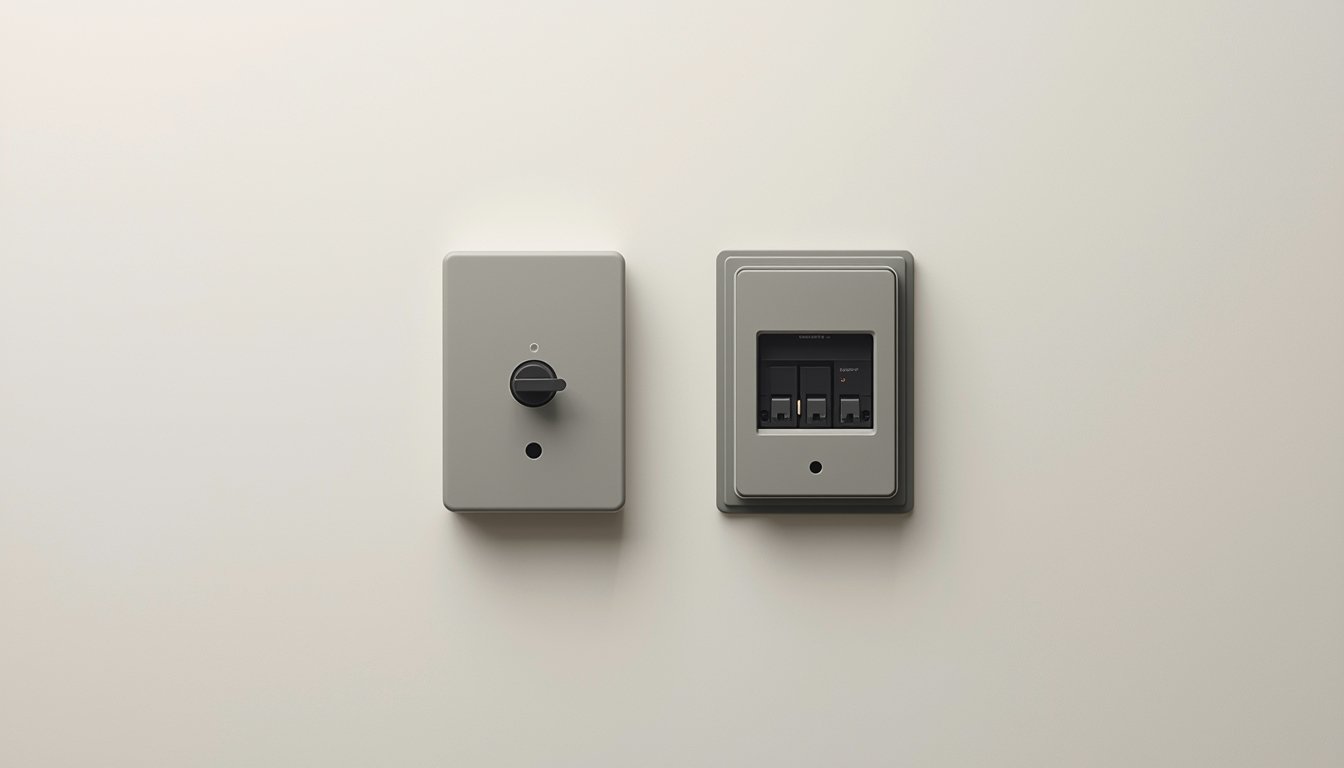
- The consumer unit: A single-phase main switch is one-pole wide (approximately 18mm); a three-phase main switch is three-poles wide (approximately 54mm) with ganged toggles.
- Your DNO or electricity supplier: Calling with your MPAN number, or entering your postcode at the Energy Networks Association website (energynetworks.org), will confirm it definitively.
During a Glow survey, we assess your electrical infrastructure as part of the standard process — including supply type, main fuse rating, consumer unit condition and available headroom.
Can you upgrade to three-phase? And should you?
A single-to-three-phase upgrade is possible. It involves applying to your local DNO, excavation to replace the supply cable from the street, a new meter box, a new consumer unit, and coordination between three separate parties (DNO, electricity supplier and electrician). The process typically takes six to sixteen weeks.
The disruption is considerable — driveway excavation, council permits and potential disruption to neighbouring properties are all common.
For the vast majority of homes, upgrading is unnecessary. The better alternatives are almost always a fuse upgrade, export limitation for larger solar systems, smart energy management, and battery storage as a load buffer. A three-phase upgrade is genuinely warranted only for very large properties with heat pumps exceeding approximately 14kW, homes where total assessed demand regularly exceeds 100A, or properties requiring 22kW EV charging for operational reasons.
Five things that confuse the conversation
This topic generates a surprising amount of misunderstanding. Here are the most common ones we encounter:
“You need three-phase for solar.” Not true. The vast majority of UK residential solar is single-phase. Systems up to 3.68kW connect under simple G98 notification; larger systems use G99 or export limitation. Capable, well-designed systems operate on single-phase every day across the country.
“Three-phase is always better.” Not necessarily. For most homes, it introduces complexity that simply isn’t needed. Three-phase consumer units are more involved, smart meters have historically been harder to obtain on three-phase, and load balancing across phases adds design considerations that don’t exist with single-phase.
“Single-phase can’t handle modern energy systems.” It can. With intelligent design — smart EV chargers, battery buffering and load management — a 100A single-phase supply comfortably runs solar, battery storage, an EV charger, a heat pump and an induction hob. The key is how the system is designed, not the supply it runs on.
“You can’t install more than 3.68kW of solar on single-phase.” This is the most common misconception. The 3.68kW figure is only the G98 notification threshold for inverter output. Larger panel arrays paired with capped inverters, G99 approval, or export limitation all enable significantly larger systems — routinely 6kW, 8kW or more.
“Three-phase means three times the electricity.” It means three times the capacity — the ability to deliver power simultaneously. Your electricity consumption is measured in kWh, and your tariff rate is the same regardless of phase type. A three-phase supply doesn’t reduce your energy use.
The bigger picture
The UK is in the middle of a significant shift in how homes consume energy. Over 1.85 million homes now have solar PV. More than 1.3 million battery electric vehicles are on UK roads. Heat pump installations reached nearly 60,000 in 2024 — a 43% increase year on year. Each of these technologies places new demands on the household electrical supply that didn’t exist a decade ago.
Ofgem approved £28 billion of energy network investment for 2026–2031, with a further £90 billion potentially flowing across gas and electricity networks over the same period. The scale of the challenge is acknowledged at every level.
“The local electricity distribution grids are central to the Government’s clean power mission and the wider transition to net zero, enabling the decarbonisation of heat, transport and industry.”
— Steve McMahon, Director for Network Price Controls, Ofgem (April 2025)
These grid investments will take time. In the meantime, well-designed home energy systems — working intelligently within existing supply constraints — represent the most practical path to a fully electrified home.
What this means in practice
Your electricity supply type is one input in a wider system design. It matters, but not in the way most people assume. A single-phase home with a well-designed energy system — appropriately sized inverter, battery storage for load buffering, a smart EV charger, and intelligent energy management — will outperform a poorly designed three-phase installation.
The intelligence of the system design matters more than the phase of the supply. That’s where an experienced designer will be understanding not just the equipment, but how it works together within the specific constraints of your property.
If you’re at the early stages of thinking about a home energy system and aren’t sure where your electrical supply fits in, that’s entirely normal. It’s one of the first things we assess, and one of the easiest to resolve.